
Style & Light Guide · Hawthorne & Reed
How to size and style a coffee table, and light the room around it
Most rooms that feel flat aren’t missing furniture. They’re missing a well-placed table and the right light. This guide walks you through both in plain terms: the measurements designers work from, why they work, and small changes you can try tonight with what you already own.
What do you want to learn?
Tables 01–03
Lighting 04–07
- Layer your lightingUse ambient, task and accent light so the room stops looking flat.5 min read
- Color temperature (kelvin)Choose warm or cool bulbs, and read the box with confidence.5 min read
- Lamp height, shade & placementSize a lamp to its table and hide the bulb from every seat.5 min read
- Light a room at nightSwap the overhead for a warm, lamp-lit evening.4 min read
Ask the guide
25 answers
No quick answer matches that yet. Try a single word, or browse the topics.
How long should my coffee table be?
A widely used rule of thumb is about two-thirds the length of your sofa. Anywhere from half to two-thirds works; an 84 in (213 cm) sofa suits a table of about 42–56 in (107–142 cm).
Read more: Size your coffee tableHow tall should a coffee table be?
Aim for a top level with your sofa seat or an inch or two lower. Most coffee tables are 16–18 in (41–46 cm) tall, which suits a typical 17–19 in seat.
Read more: Size your coffee tableHow far should the coffee table be from the sofa?
About 14–18 in (36–46 cm): room for your knees, and close enough to set a cup down without getting up.
Read more: Size your coffee tableWhat size coffee table goes with a sectional?
Measure the longest straight run of seats, not the chaise, and size the table to about half to two-thirds of that. If both arms are similar, a square or round table serves both sides.
Read more: Size your coffee tableRound or rectangular coffee table?
A rectangle or oval follows the long line of a standard sofa. In a small room, a busy walkway or a home with small children, a round or oval table is easier to move around and has no corners at shin height.
Read more: Size your coffee tableWhat coffee table works if drinks go down without coasters?
Choose a sealed finish (lacquered or varnished) or a non-wood top. Oiled wood marks more easily, and acidic drinks can leave dull marks on marble even when it’s sealed.
Read more: Size your coffee tableHow much walking space do I need around the coffee table?
Keep main paths 30–36 in (76–91 cm) wide. Where nobody walks, about 12 in (30 cm) between the table and other furniture is enough.
Read more: Size your coffee tableWhat size rug goes under a coffee table?
Big enough for the whole table plus at least the front legs of every seat. For most living rooms that’s 8×10 ft or 9×12 ft.
Read more: Size your coffee tableHow do I style a coffee table?
Clear it, anchor it with a tray or a stack of books, then add one tall, one medium and one low piece. Step back, take one thing away and leave about a third clear.
Read more: Style your coffee tableWhere do the remotes and coasters go?
Give them one home: a tray or a lidded box on or near the table. It turns loose clutter into one tidy group that lifts off in a second.
Read more: Style your coffee tableHow tall can things on a coffee table be?
Keep the tallest piece to about a foot (30 cm), so you can still see the person across from you.
Read more: Style your coffee tableHow tall should a side table be next to a sofa?
About level with the sofa arm, or up to 2 in (5 cm) lower, so your hand falls naturally onto it. More than about 4 in (10 cm) above the arm rarely works.
Read more: Side tables & consoles: a home for the lampWhat should go on a console table?
Let a lamp be the tall point of a triangle, add something medium and something low, then stop. Leave about a third of the top clear.
Read more: Side tables & consoles: a home for the lampWhy does my room feel flat at night?
One overhead light lights everything from straight above, so faces look shadowy and the corners stay dark. Add lamps at two or three heights and dim the overhead.
Read more: Layer your lightingHow many lamps does a living room need?
Most designers suggest at least three to five light sources, and many aim for five to seven in a larger room, spread across different heights.
Read more: Layer your lightingHow many lumens do I need?
A rough guide for a living room is 10–20 lumens per square foot. A 12×15 ft room lands around 1,800–3,600 lumens, about two to four ordinary 800-lumen bulbs.
Read more: Layer your lightingWhat kelvin should I use in a living room?
Around 2700K, warm white, is the easy default for living rooms, bedrooms and dining rooms. 3000K is still warm, just a little crisper.
Read more: Color temperature (kelvin)Should I buy daylight bulbs to see better?
No: brightness comes from lumens, not kelvin. Buy more lumens for more light, and keep cooler bulbs for a desk or task lamp only.
Read more: Color temperature (kelvin)What is CRI and what should I buy?
CRI tells you how true colors look under a bulb: wood, fabric, skin. Look for CRI 90 or above where you spend time; 80 is the common baseline if budget is tight.
Read more: Color temperature (kelvin)How tall should a lamp on a side table be?
A common rule of thumb: table and lamp together reach about 58–64 in (147–163 cm). The real check is to sit down: the bottom of the shade should be about at your eye level.
Read more: Lamp height, shade & placementWhat size lampshade do I need?
About as wide as the base is tall, and never wider than the table it sits on. If you can see the socket or bulb from your seat, the shade is too small.
Read more: Lamp height, shade & placementWhere should a reading floor lamp go?
Just beside or slightly behind your shoulder, with the bottom of the shade about level with your eyes when you sit, so the light falls onto the page.
Read more: Lamp height, shade & placementHow do I make my living room cozy at night?
Turn the overhead off or right down and let three or more warm lamps at different heights do the work. If the room still works on lamps alone, your lighting is right.
Read more: Light a room at nightHow high should a light hang over a dining table?
With its bottom about 30–36 in (76–91 cm) above the tabletop on an 8 ft ceiling, and about 3 in (8 cm) higher for each extra foot of ceiling.
Read more: Room by roomWhich side should a desk lamp go on?
The side opposite your writing hand, so your hand doesn’t shadow the page: right-handed, lamp on the left.
Read more: Room by room
Size your coffee table
Before you think about what goes on a coffee table, get the table itself right. Size decides almost everything: whether you can reach a drink, whether people squeeze past knees, whether the seating reads as one group. The good news is that it comes down to a few measurements you can take in five minutes with a tape measure.
The short answer
Choose a table about two-thirds the length of your sofa, with a top level with the seat or an inch or two lower, set 14–18 in (36–46 cm) from the sofa.
Interactive
Coffee-table sizer
Enter two measurements. The results are common rules of thumb, not fixed rules; trust the tape-on-the-floor test if the two disagree.
Arm to arm across the front. For a sectional, the longest straight run of seats, not the chaise.
Most sofa seats are 17–19 in. Measure without sitting on it.
Your starting point
For an 84 in (213 cm) sofa with an 18 in (46 cm) seat:
- Table length: about 42–56 in. Two-thirds of your sofa, the figure most people aim for, is about 56 in.
- Table height: 16–18 in is the sweet spot; anything from 14 to 19 in still works.
- Distance: leave 14–18 in between the front of the sofa and the table.
- Paths: keep 30–36 in (76–91 cm) clear wherever people walk around it.
- Standard three-seat sofa: a rectangle or oval echoes its length and gives the most usable surface. If the sofa is all straight lines, an oval adds a welcome curve.
Length: about two-thirds of the sofa
A widely used rule of thumb is a table about two-thirds the length of your sofa. Anywhere from half to two-thirds works; much past two-thirds starts to crowd the ends, and much under half looks lost. An 84 in (213 cm) sofa suits a table of about 42–56 in (107–142 cm); a 90 in (229 cm) sofa, about 45–60 in (114–152 cm).
Height: level with the seat, or a little lower
Aim for a tabletop level with your sofa seat or an inch or two lower (1–2 in, 3–5 cm). Up to about 4 in (10 cm) lower still works; more than about 1 in (3 cm) higher rarely does. Most coffee tables are 16–18 in (41–46 cm) tall, which suits the typical 17–19 in sofa seat; the wider range on the market is about 14–20 in (36–51 cm).
Distance: close enough to reach, far enough for knees
- Leave about 14–18 in (36–46 cm) between the front of the sofa and the table. About 12 in (30 cm) is the tight minimum; much past 18 in (46 cm) and a drink is a stretch away.
- Every seat that will hold a drink needs a surface within about 18 in (46 cm): the coffee table or a side table.
- Keep main paths around the table 30–36 in (76–91 cm) wide; 36 in lets two people pass without turning. Nobody should have to cut through the middle of the seating to cross the room.
- Where nobody walks, about 12 in (30 cm) between the table and other furniture is enough.
More on sizing 5 more notes Shape, visual weight, material, hard and soft materials, the rug
Shape: follow the seating
- Standard three-seat sofa: a rectangle or oval echoes its length and gives the most usable surface. If the sofa is all straight lines, an oval adds a welcome curve.
- Loveseat or small settee: a smaller round or square table keeps things in proportion.
- L-shaped sectional with two similar arms: a square or round table sits in the corner and serves both sides.
- Sectional with one long run or a chaise: measure the longest straight run of seats (not the chaise), size a rectangle or oval to about half to two-thirds of it, and center it on that run. Keep the open side clear as the walkway.
- Seats on three sides (a U-shape): a round or generous square table puts every seat within similar reach.
- Two sofas facing each other: leave 14–18 in on each side and let the table fill what’s left, so table depth is the sofa-to-sofa distance minus about 28–36 in (71–91 cm). Keep the group within roughly 10 ft (3 m) across so you can talk without raising your voice.
- Small room, busy path or small children: round or oval has no projecting corners, is easier to walk around, and reads visually lighter.
- Very large sectional or a small space: two or three nesting tables tuck together day to day and pull apart when people come over. Leave room to pull them out without blocking a path.
Visual weight: see-through or solid
In a small room, choose a table you can see floor under: slim legs, glass, an open frame or a thin top. In a big room, a solid, weightier table (a drum or plinth base, thick stone, heavy timber) helps anchor the seating. Balance the pair: a leggy sofa suits a solid table, and a heavy block of a sofa suits a lighter one.
Material: choose for how you actually live
- Small children: round or oval shapes, or a padded ottoman with soft edges.
- Feet up: a padded ottoman or sturdy sealed wood. An ottoman has no hard surface, so give it a large, flat-bottomed tray for drinks.
- Drinks without coasters: a sealed (lacquered or varnished) finish or a non-wood top. Oiled and waxed wood marks more readily, though small scratches can be spot-repaired.
- Marble: it can stain, and acidic drinks such as wine, citrus or soda etch dull marks even when it’s sealed. Use coasters and a tray, or enjoy the patina.
- Glass: check that it’s tempered, and expect to wipe it often.
- Pets: a sturdy base and a sealed or wipe-clean top.
- Eating or working on the sofa: a lift-top brings part of the surface up toward you and hides clutter underneath.
- Solid wood vs veneer: solid wood can be sanded and refinished when it gets marked; veneer stays flatter and more stable, but deep damage is hard to fix. It’s repairability versus stability, not simply better or worse.
Balance hard materials with soft ones
A wood table warms a room on its own. Stone, metal and glass feel grounding but can read cold by themselves, so give them softer company: a wool rug, linen cushions, warm lamplight. One sculptural glass or acrylic piece works well as an accent, not as the whole room.
The rug sets the boundary
The coffee table should sit fully on the rug, with at least the front legs of the sofa and chairs on it too. For most living rooms that means 8×10 ft or 9×12 ft, with the rug running at least 6 in (15 cm), ideally about 8 in (20 cm), past each end of the sofa. Leave roughly 18–24 in (46–61 cm) of floor showing around it in a large room, about 10–18 in (25–46 cm) in a small one.
Try this
- Measure your sofa from arm to arm across the front. With a sectional, measure the longest straight run of seats instead.
- Measure from the floor to the top of the seat cushion.
- Put both numbers into the coffee-table sizer above to get a length, height and distance.
- Mark the table’s outline on the floor with painter’s tape or folded newspaper, 14–18 in from the sofa.
- Sit in every seat and reach for the tape. Then walk every path around it. If you lean or squeeze, adjust the outline before you buy.
Watch out
Don’t measure a sectional’s full length or include the chaise. You’ll get a table that crowds the ends and blocks the walkway.
Style your coffee table
A styled coffee table isn’t a display shelf. It’s a working surface that also looks good. Start from what you actually use, give the small stuff a home, and add a few pieces at different heights. Then stop sooner than you think you should.
The short answer
Anchor with a tray or books, add one tall, one medium and one low piece, and leave about a third of the table clear.
The filter: practical, beautiful or personal
Every object on the table should earn its place by being something you use, something you find beautiful, or something that means something to you. Skip filler bought just to fill a surface. One designer’s rule of thumb goes further: keep roughly 80% of your things put away and let about 20% be on show. The surface reads calmer, and what’s left gets noticed.
Five steps, in order
- Clear it completely.
- Anchor it with a tray or a stack of books.
- Add one tall piece: a vase with a few stems or branches.
- Add a medium piece: a bowl, or a candle set on the books.
- Add one low piece that’s personal or natural. Then step back, take one thing away, and leave about a third clear.
Three heights, loosely a triangle
Mix one tall, one medium and one low piece so their tops trace a loose triangle. On a coffee table, keep the tallest to about a foot (30 cm); much taller blocks the view of the person opposite.
Interactive
Keep it or put it away?
Pick up each object on your coffee table and answer three questions.
One yes is enough to keep it on the table.
More on styling 6 more notes Groups of three, the remote and coasters, books, one natural thing, clear space, long or round tables
Group in threes
A long-standing styling rule of thumb: group things in threes, or fives on a big table. A stack of books counts as one item.
Give the remote and coasters a home
Plan for the everyday things. A tray turns five loose objects (remote, coasters, a candle, a lighter) into one tidy group that reads as a single item and lifts off in a second when you need the surface. A lidded box hides them completely.
Books as a base or a riser
Stack a few books flat. Use the stack as your low piece, or as a plinth that lifts a small bowl or candle to medium height. Choose books you’ve read or mean to read.
One living or natural thing
Add one organic piece per surface: a few stems, a small plant, cut branches, a stone, a piece of wood or a shell. It keeps the arrangement from looking staged.
Leave room to live
Leave roughly a third of the surface clear, and make sure every seat has a clear spot to put a cup down. Empty space is what lets the objects you chose read clearly.
Long table or round table
- Long rectangle: think in zones. Make one or two groupings and leave the rest open rather than spreading objects end to end.
- Round or square: one cluster in the middle is enough, with clear space around the rim.
Try this
- Take everything off the table.
- Put the remote, coasters and anything else you reach for daily on a tray.
- Add a stack of two or three books you actually like.
- Add one thing that’s tall (stems in a vase) and one that’s natural (a stone, a small plant).
- Sit on the sofa, take one thing away, and check there’s a clear spot in front of every seat.
Watch out
If you style a marble or oiled-wood table, keep drinks on the tray or a coaster: acidic drinks can etch marble and rings mark oiled wood.
Side tables & consoles: a home for the lamp
In this guide, side tables and consoles have two jobs: holding a lamp at the right height, and backing up the coffee table with a place to set things down. Get the height right, let the lamp lead, and keep everything else small.
The short answer
Keep a side table about level with the sofa arm, and put a lamp, one book, one natural thing and a clear spot for a cup on it. That’s enough.
Side table height and distance
- Level with the sofa arm or up to about 2 in (5 cm) lower, so your hand falls naturally onto it. If in doubt, go lower.
- More than about 4 in (10 cm) above the arm rarely works.
- One designer’s rule of thumb: no deeper than the sofa or chair beside it, set about 2–3 in (5–8 cm) from the arm.
What goes on a side table
A lamp (unless a floor lamp stands beside it), one book or a short stack, one natural element, and a clear landing spot for a cup or glass. This is the coffee table’s partner: if a seat can’t reach the coffee table, the side table is where its drink goes.
Console sizes
- Consoles are commonly about 28–34 in (71–86 cm) tall, 30 in (76 cm) most often, and 12–18 in (30–46 cm) deep.
- In an entry, 12–16 in (30–41 cm) deep keeps the path clear.
- Behind a sofa, choose a console no taller than the sofa back, and let some sofa show at each end.
Style a console as a triangle, with the lamp at the top
Let the lamp be the tall point (or a mirror or art above), add something medium (a vase, or a bowl on books) and something low (a tray, a box, a few books). Their tops trace a triangle. Group in odd numbers, leave about a third of the top clear, and in an entry add a catch-all tray or bowl for keys.
Interactive
Edit it down
The same console, before and after an edit.
Press the button to switch between the cluttered and edited console.
BeforeAfter
After: the lamp as the tall point, a bowl on books in the middle, a tray at the low end, and a third of the top left clear.
More on consoles 2 more notes Two lamps or one, a mirror or art above
Two lamps or one
A matching pair of lamps near each end with something low between them reads formal and suits a long console or a table behind a sofa. One lamp balanced by a stack of books and an object on the other side reads relaxed. Either way, balance the visual weight, not the objects.
A mirror or art above
A widely used guideline: about two-thirds the width of the furniture below, so a 48 in console takes roughly a 32–36 in mirror. Hang it closer than you think, roughly 4–10 in above the console, so the two read as one composition.
Try this
- Clear the console or side table completely.
- Put the lamp back first, toward one end on a console, toward the back corner on a side table.
- Add one medium piece and one low piece.
- Leave a clear spot the size of a mug.
- Take one thing away, then look again from across the room.
Watch out
A side table much taller than the sofa arm puts the lamp and your drink at an awkward height; check it before you move the lamp.
Layer your lighting
If a room feels flat or a bit cold even with nice furniture in it, the light is usually the reason. A single ceiling fixture can light a room, but it can’t make it feel good. Designers solve this by building light in three layers, from several sources at different heights.
The short answer
Use at least three to five sources across ambient, task and accent light, at different heights, and put the overhead on a dimmer.
The three layers
- Ambient: general light to see and move around by. Ceiling fixtures, recessed lights, torchiere uplights.
- Task: brighter, focused light for doing something. A reading lamp, a desk lamp, a pendant over a table.
- Accent: light that draws the eye or adds a glow. A picture light, an uplight in a corner, a small lamp on a shelf.
- The layers overlap in practice: a shaded table lamp can count as ambient or task.
Why one overhead light makes a room look flat
A single ceiling source lights everything from straight above. It casts shadows into eye sockets and under chins, removes the modeling that gives objects shape, and leaves walls and corners dim. Overhead light isn’t the problem; overhead-only is.
Treat the overhead as a work light
Use the ceiling fixture at full brightness when you need to see everything: cleaning, hunting for something, hosting. The rest of the evening, dim it or switch it off and let lamps do the work. Put the overhead on a dimmer (an LED-rated one, with dimmable bulbs); for lamps, a plug-in dimmer does the same job with no wiring.
How many sources
Most designers suggest at least three to five light sources in a living room, and many aim for five to seven in a larger room. No standards body sets a number; what matters more is spreading them across heights: something tall (a floor lamp), something at table height, and something low or on the wall.
Interactive
Switch the layers
Turn each layer on and off to see what it adds to the room.
Each button turns one layer on or off in the drawing.
All three layers: light at several heights, a place to read, and edges that glow. This is the balance to aim for.
More on layering 6 more notes Task light, how much light in total, the edges of the room, accents, hiding the bulb, dimmers
Task light has to reach the task
Put task light where the task is, and aim it there: a reading lamp beside the chair you actually read in, a dining light that shines down onto the table rather than up at the ceiling. For a dedicated reading lamp, a bulb around 450–800 lumens is a common range; go toward the top if your eyes want more light.
How much light in total
- A rough guide for a living room: 10–20 lumens per square foot of general light, spread across several lamps.
- Multiply the room’s square footage by 10–20. A 12×15 ft room (180 sq ft) lands around 1,800–3,600 lumens, about two to four ordinary 800-lumen bulbs.
- Treat it as a starting estimate: shades and dark walls absorb light.
- Shop by lumens, not watts: about 800 lumens is the old 60-watt bulb, 450 lumens a 40-watt, 1,100 a 75-watt and 1,600 a 100-watt. An 800-lumen LED draws roughly 8–12 watts.
Light the edges of the room
Lighting research going back to the 1970s has found that light on the walls and corners, not just the center, makes a room feel bigger and more relaxed. If you add only one thing, try a light in a corner aimed up or at a wall. A broad, even wash is more forgiving than a steep graze, which shows every flaw in the plaster.
Accents need contrast
An accent only stands out if it’s brighter than what’s around it; roughly three times brighter is a common rule of thumb. Dimming the room light makes your accents look stronger for free.
Hide the bulb
If you can see a bare bulb from where you sit, it will glare. Fix it with a bigger or deeper shade, a frosted bulb, or a lower-output bulb. Fixtures above eye level, like a dining pendant, need a closed bottom, a diffuser or a shielded bulb.
Dimmers, and dimming LEDs
Put lights on dimmers wherever you can, ideally with each layer on its own switch, so the same fixtures go from bright for cleaning to low and lamp-led at night. On a dimmer, use bulbs marked ‘dimmable’ and a dimmer rated for LEDs; if it flickers or hums, try another bulb. For plug-in lamps, a plug-in or inline lamp dimmer or a dimmable smart bulb needs no electrician.
Try this
- Stand in the doorway after dark and count the light sources that are on.
- Note which heights they cover: ceiling, standing, table, low.
- Fill the missing height first, usually a lamp at table height or a light in a dark corner.
- Put a dimmer on the overhead, or a plug-in dimmer on your main lamp.
- Switch the overhead off and see whether the room still works.
Watch out
Adding lamps in a line along one wall doesn’t layer the room. Spread them around the seating and across heights.
Color temperature (kelvin)
Two bulbs can be equally bright and still make a room feel completely different. The difference is color temperature, measured in kelvin (K). It’s printed on every box, and once you know what the number means, choosing bulbs gets easy.
The short answer
Use about 2700K (up to 3000K) in rooms you relax in, keep cooler light for a desk or work surface, and keep every bulb in a room close in color.
What kelvin tells you
Kelvin describes the color of white light, not its brightness and not its heat. Lower numbers look warmer and more amber; higher numbers look whiter and bluer. Brightness is lumens, a separate number on the same box.
What each number feels like
- About 2000–2200K: candle-like amber, low and intimate. For late evening, accent glows and a dimmed lamp before bed; too dim-feeling for reading.
- About 2400K: very warm and soft, a shade warmer than a classic bulb. A relaxed evening lamp.
- About 2700K: classic warm white, the color of an old incandescent bulb. The default for living rooms, bedrooms and dining rooms.
- About 3000K: still warm, a little crisper. Living spaces where you also read or cook.
- 3500K and up: neutral to cool. Desks and work surfaces by day; clinical in a living room at night.
Warmer or cooler?
Use warm light (about 2700–3000K) where and when you relax: living rooms, bedrooms, dining rooms, evenings. Use neutral to cool light (about 3500–5000K) where you need focus and clear visibility, such as daytime desk work, kitchen counters and vanities. Tunable fixtures can move from cool by day to warm by evening.
Don’t buy daylight bulbs “to see better”
A common mistake is fitting cool, daylight bulbs everywhere for more brightness. It makes a home feel sterile, and it doesn’t work: brightness comes from lumens, not kelvin. For more light, buy more lumens. Keep a cooler bulb for a dedicated task light only, and about 2700K for the main lamps.
Interactive
Kelvin slider
Move the slider to see roughly how each color temperature looks and where it works.
- About 1800–2400K
- About 2700K
- About 3000K
- About 3500–4100K
- Toward 5000K
2700K · Warm white: the color of a classic incandescent bulb
Good for: The easy default for lamps in living rooms, bedrooms and dining rooms
Screens can’t show real light exactly; the swatch and tint are approximations.
 Simulated tint
More on bulbs 5 more notes One color per room, dim-to-warm bulbs, CRI, reading the box, evening light
Keep one color temperature per room
Keep the bulbs in a room at the same or similar color temperature. A cool bulb next to warm ones makes one lamp look wrong and the room look patchy. If you mix on purpose, say warm ambient light plus a slightly cooler task lamp, keep them close.
Dim-to-warm bulbs
Dim-to-warm LEDs start at about 2700–3000K at full output and turn more amber as you dim them, the way old incandescent bulbs did; some reach candle-like tones around 1800K. An ordinary LED just gets dimmer at the same color.
CRI: how true colors look
CRI (color rendering index, 0–100) scores how faithfully a bulb shows the real colors of wood, fabric and skin. It’s separate from kelvin: a 2700K bulb can have a high or low CRI. Look for CRI 90 or above for living rooms, bedrooms and dining rooms; about 80 is the common baseline if budget is tight or for utility spaces.
Read the box
Turn the box over. On the US Lighting Facts label, ‘Light Appearance’ is the kelvin number, shown on a warm-to-cool scale. CRI is usually printed nearby or in the bulb specs.
Evening light
Sleep experts generally advise dimmer, warmer light in the hours before bed; bright, cool light is more alerting. In practice: lower and warmer as the evening goes on.
Try this
- Check the ‘Light Appearance’ number on the bulbs in your main room.
- Swap any bulb above 3000K in a living-room, bedroom or dining lamp for a 2700K one (a desk or task lamp can stay cooler).
- When you buy, look for CRI 90 or above on the box.
- Try one dim-to-warm bulb in the lamp you use latest in the evening.
Watch out
Retail names like ‘soft white’ and ‘bright white’ aren’t used consistently. Go by the kelvin number, not the name.
Lamp height, shade & placement
A good lamp in the wrong spot, or at the wrong height, still glares or leaves you reading in the dark. The fix is less about the lamp and more about three checks: where you sit, where the shade ends, and whether you can see the bulb.
The short answer
Sit down: the bottom of the shade should be about at your eye level. As a starting point, table and lamp together reach about 58–64 in (147–163 cm).
Interactive
Lamp sizer
Tell us where the lamp will go and how tall the table is.
Floor to the top of the table.
Your starting point
For a 26 in (66 cm) side table next to a sofa:
- Lamp height: about 32–34 in, so table and lamp together reach about 58–64 in (147–163 cm).
- Shade bottom: at roughly seated eye level, about 38–42 in (97–107 cm) from the floor. Sit down and check.
- Shade width: about as wide as the lamp’s base is tall, and no wider than your tabletop.
Beside the sofa: the sit-down check
The bottom of the shade should sit at roughly seated eye level, so light falls on your lap and page and you see the glow, not the bulb. On a typical sofa that’s roughly 38–42 in (97–107 cm) from the floor, but sit down and check. A common rule of thumb is table and lamp together at about 58–64 in (147–163 cm); most table lamps are about 24–34 in (61–86 cm) tall. If the numbers and the sit-down check disagree, trust the sit-down check.
Shade size
- Diameter about as wide as the lamp’s base is tall (bottom of the base to the socket), or about twice the base’s widest point.
- Shade height about two-thirds of the base height.
- Never wider than the table it sits on.
- Deep enough to hide the socket and harp. If you can see hardware or the bulb from your seat, the shade is too short or too narrow.
Put lamps where people sit
Place lamps for how the room is used: beside the seat you read in, at the end of the sofa you favor, by the bed. A lamp in an empty corner because it looks nice there does less than one beside the chair you use every evening.
More on lamps 4 more notes Shade material, bedside, on a console, reading floor lamps
Shade material
Lined or opaque shades push light down, which is better for reading and cuts glare near eye level. Linen or paper shades glow all around for mood, but show a hot spot if the bulb is too bright.
Bedside
- Nightstand top about level with the mattress top, within about 2 in (5 cm).
- Bedside lamps are commonly 24–30 in (61–76 cm) tall.
- Sit up against the headboard: the bottom of the shade should be around chin or eye level.
- Keep both sides a similar scale.
- For a wall-mounted reading light, sit in bed as you read and mount it a few inches above your shoulder.
On a console
A console is seen standing, so its lamp can be taller. Console plus lamp at about 58–64 in is the common starting point (some guides say 62–68 in); a 30 in console typically takes a 28–34 in lamp. Go a little shorter if a mirror or art hangs above.
Floor lamps for reading
Put a reading floor lamp just beside or slightly behind your shoulder, on the side of the hand that holds the book less. The bottom of the shade should be about level with your eyes when you sit, roughly 40–49 in (102–124 cm) from the floor. Typical reading floor lamps are around 58–64 in tall.
Try this
- Sit in your usual seat next to the lamp.
- Look straight ahead: can you see the bulb or socket? If so, the shade is too small, too shallow or too high.
- Check where the shade ends. Around your eye level is right.
- Stand back and compare the shade with the tabletop: it shouldn’t overhang.
- Measure the table and use the lamp sizer above before you buy a new lamp.
Watch out
On an end table lower than about 24 in (61 cm), a 58–64 in total would need a lamp taller than most table lamps. Choose one whose shade bottom lands near your seated eye level, and let the sit-down check decide.
Light a room at night
Most living rooms are planned in daylight and lived in after dark. The evening is when a room most needs help, and when a few lamps make the biggest difference. Here’s a simple routine for switching over from daytime light to a warm, comfortable evening.
The short answer
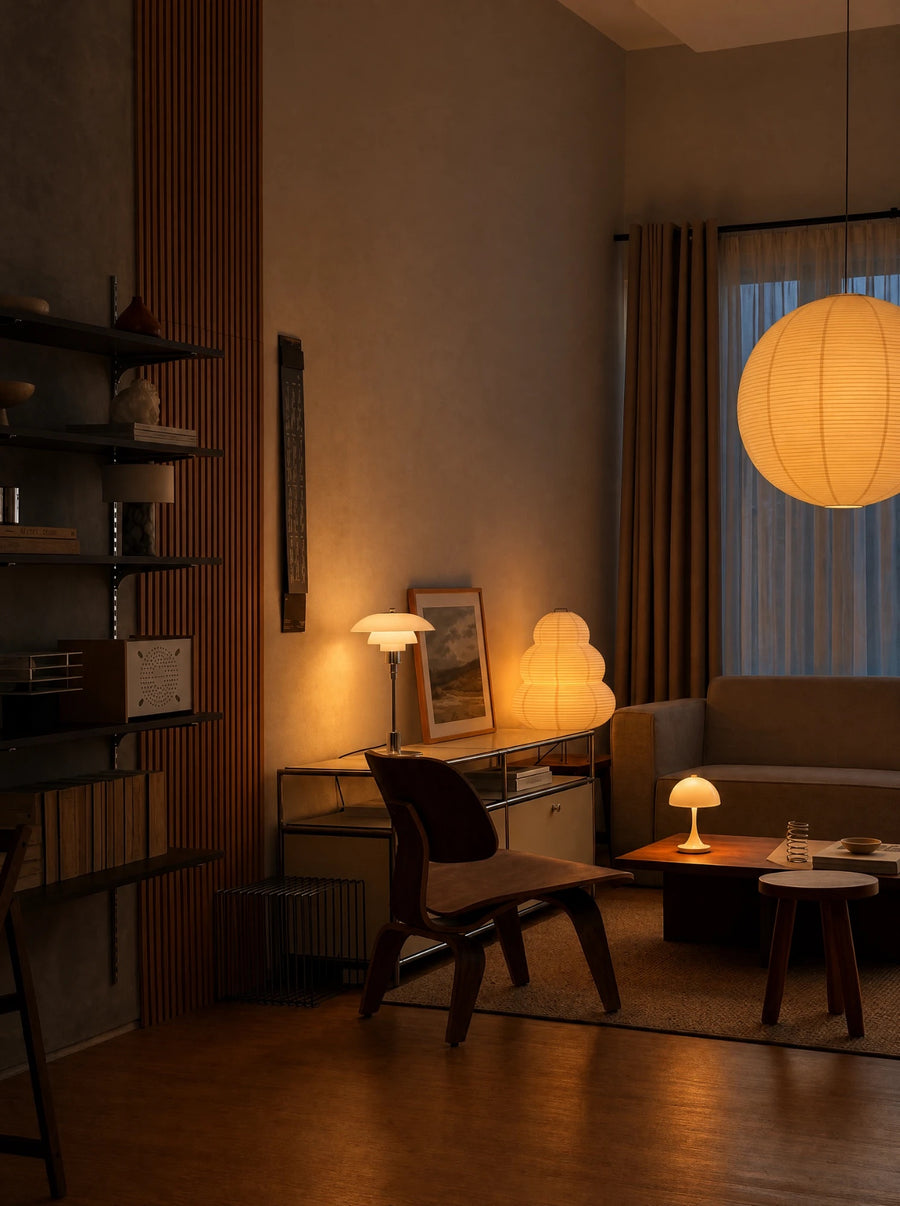
At night, switch the overhead off or right down and let three or more warm lamps at different heights do the work.
Interactive
Day and evening
The same room shown in daylight and in the evening, lit only by lamps. Drag to compare.
Use the slider or the arrow keys to reveal more of either image.
The test
Turn off the overhead light. If the room still feels comfortable and usable on lamps alone, your lighting is right. If it doesn’t, the rest of this section shows what to add.
A triangle of light
A simple starting pattern: three lamps in a loose triangle around the seating, for example a floor lamp in one corner, a table lamp by a chair and a lamp on the console behind the sofa. The pools of light overlap and lead the eye around the room instead of stopping at one bright spot.
More for the evening 4 more notes One dark corner, small glows, lower and warmer, lamps on timers
Light one dark corner
A floor lamp or a small uplight in a dark corner, or behind a plant, carries light to the edges of the room and makes it feel larger and calmer.
Small glows count
Add one or two small glows that do no job except make the room feel lived in: a little lamp on a shelf, a picture light, a candle. They make every other light work better. A picture light about half to two-thirds the width of the art is a common guideline, and plug-in or battery versions avoid wiring.
Lower and warmer
In the evening, go lower and warmer: dimmed lamps at around 2700K or below. Dim-to-warm bulbs do both at once. Sleep experts generally advise dimmer, warmer light before bed.
Let the lamps switch themselves
Plug-in timers, smart plugs or smart bulbs can bring several lamps on at dusk and dim them later, so the room is lamp-lit without walking around to every switch.
Try this
- Dim the overhead light, or switch it off.
- Turn on three or more lamps at different heights: a floor lamp, table lamps, something low.
- Check the bulbs are warm, around 2700K, and all a similar color.
- Light one wall or dark corner.
- Add one small glow: a shelf lamp or a candle.
- Put the lamps on dimmers, timers or smart plugs so this happens on its own tomorrow.
Watch out
Lamps bunched together on one side of the room leave the other half dark. Spread them around the seating.
Coffee table & lighting mistakes
Most rooms that feel slightly off share the same few problems, and almost all of them are cheap to fix. Open any card to see why it feels wrong and what to do.
The short answer
Most fixes come down to two moves: size and place the table for reach, and dim the overhead in favor of warm lamps at several heights, with their shades hiding the bulb.
The coffee table is too small or too far away
Why it feels off
A table much under half the sofa length looks lost, and more than about 18 in (46 cm) away you have to lean to reach it.
The fix
Size it to about two-thirds of the sofa and pull it to 14–18 in (36–46 cm) from the seat.
Buying the table for the photo, not for your house
Why it feels off
A marble or oiled-wood top in a home where drinks go down without coasters, or sharp corners at toddler height, will frustrate you daily.
The fix
Choose for how you live: a sealed finish for drinks, round or oval for small children, an ottoman or sturdy wood if feet go up.
No room to put a cup down
Why it feels off
Covering every inch of the table leaves nowhere for a drink and reads cluttered.
The fix
Group things in threes on a tray, then leave about a third of the table clear.
A centerpiece that blocks the view
Why it feels off
A tall arrangement on a coffee table cuts across the sightline between seats.
The fix
Keep the tallest piece to about a foot (30 cm).
A rug that floats under the table
Why it feels off
A rug only under the coffee table, with no seat legs on it, makes the seating group look disconnected.
The fix
Go up a size so at least the front legs of every seat sit on it.
Relying on the overhead light
Why it feels off
One source straight above gives flat, shadowy light and dark corners.
The fix
Dim or switch off the overhead and add lamps at two or three heights.
Daylight bulbs in living spaces
Why it feels off
Bulbs of 5000K and up make a living room feel clinical at night.
The fix
Use 2700K (up to 3000K) in lamps, and keep cooler light for a desk or work zone.
Mixed bulb colors in one room
Why it feels off
A cool bulb among warm ones makes one lamp look wrong and the room look patchy.
The fix
Match the bulbs within a room; check ‘Light Appearance’ on the box.
You can see the bare bulb
Why it feels off
A shade that’s too small, too shallow or too high lets the bulb glare into seated eyes.
The fix
Bring the shade bottom to seated eye level, choose a deeper or wider shade, or use a frosted bulb.
A lamp the wrong size for its table
Why it feels off
A tiny lamp on a big table looks lost; a shade wider than the tabletop looks top-heavy and gets knocked.
The fix
Aim for table plus lamp around 58–64 in (147–163 cm) as a starting point, with a shade no wider than the table.
A lamp where nobody sits
Why it feels off
A lamp placed in an empty corner because it looks nice there leaves the chair you read in dim.
The fix
Move it beside the seat you use most, or add a reading lamp there and let a small uplight handle the corner.
A dining light hung too high
Why it feels off
A fixture near the ceiling lights the ceiling and floats, disconnected from the table.
The fix
Lower it so its bottom sits about 30–36 in (76–91 cm) above the tabletop on an 8 ft ceiling.
Room by room
The same principles apply everywhere, but each room asks for a slightly different mix. Pick a room for its light recipe, where the coffee table goes (if the room has one), and a short checklist.
The short answer
Every room: several warm sources at different heights, the overhead on a dimmer, and task light aimed at the task.
Living room
Light recipe
- Three or more sources at different heights: a floor lamp by the reading seat, table lamps at the sofa ends, and a small accent glow.
- The overhead on a dimmer, used bright only for cleaning or hosting.
- All bulbs about 2700–3000K and close in color; CRI 90 or above.
- About 10–20 lumens per square foot overall: a 12×15 ft room needs roughly 1,800–3,600 lumens.
- One light on a wall or in a dark corner.
Table & placement
- Coffee table about two-thirds the sofa’s length, with its top level with the seat or an inch or two lower.
- Set it 14–18 in (36–46 cm) from the sofa, with 30–36 in (76–91 cm) paths around it.
- Shape follows the seating: rectangle or oval for a straight sofa, square or round inside an L with similar arms, round in a tight room.
- A rug big enough for the table and at least the front legs of every seat.
- Side tables about level with the sofa arm, each holding a lamp and a clear spot for a cup.
Checklist
- Can every seat reach a surface without leaning?
- Does the room work with the overhead off?
- Are all the bulbs the same warm color?
- Is about a third of the coffee table clear?
Bedroom
Light recipe
- Warm white (2700–3000K), dimmable bedside and ambient light.
- A lamp on each side of the bed, similar in scale.
- A directional or swing-arm reading light if one of you reads while the other sleeps; mount a wall light a few inches above your shoulder as you sit in bed.
- About 10–20 lumens per square foot of general light.
- Lower and warmer through the evening; dim-to-warm bulbs help.
Table & placement
- Nightstand top about level with the mattress, within about 2 in (5 cm).
- Bedside lamps of about 24–30 in (61–76 cm), with the shade bottom around chin or eye level when you sit up.
- On the nightstand: the lamp, a book, one natural thing and room for a glass of water.
- If there’s a seating corner, give the chair a lamp and a small table within reach, the same way you would in a living room.
Checklist
- Can you switch off the light without getting out of bed?
- Can one person read without lighting the other’s pillow?
- Are both bedside lamps a similar scale?
- Is the overhead dimmable or rarely needed?
Dining
Light recipe
- A warm (about 2700K), dimmable fixture over the table that throws light down onto it.
- Bottom of the fixture about 30–36 in (76–91 cm) above the tabletop on an 8 ft ceiling; about 3 in (8 cm) higher for each extra foot (9 ft: about 33–39 in).
- Width about half to two-thirds of the table’s width (a 38 in table takes about 19–25 in) and roughly a foot narrower than the table; a linear fixture about half to two-thirds of the table’s length.
- Over a long table, two or three pendants spaced roughly 24–36 in (61–91 cm) apart, center to center.
- At least one supporting source, such as a lamp on the sideboard or a pair of sconces, so the pendant isn’t doing all the work.
Table & placement
- Choose a closed-bottom or shielded fixture so nobody seated looks into a bare bulb.
- Keep the table centerpiece low so people can see each other.
- A lamp on a sideboard or console follows the same triangle as any console: lamp tall, then medium, then low.
Checklist
- Does the light land on the table, not the ceiling?
- Can you see across the table without looking past the fixture?
- Is it on a dimmer?
- Is there a second light source in the room?
Entryway
Light recipe
- One lamp on the console: a lamp left on makes coming home feel warmer than a ceiling light.
- Any hanging fixture at least 7 ft (84 in, 213 cm) from the floor to its bottom; with a ceiling of 8 ft or lower, go flush or semi-flush.
- Sizing a ceiling fixture with no table below: add the room’s length and width in feet, and that’s roughly the fixture’s width in inches (12×14 ft: about 26 in).
- Wall sconces usually about 60–72 in (152–183 cm) from the floor.
- A plug-in timer or smart plug so the lamp is on when you walk in.
Table & placement
- Console 12–16 in (30–41 cm) deep to keep the path clear.
- Console plus lamp about 58–64 in (147–163 cm) tall.
- A mirror about two-thirds the console’s width, hung roughly 4–10 in above it.
- A tray or bowl for keys; leave the rest of the top mostly clear.
Checklist
- Can you walk past without turning sideways?
- Is there somewhere to drop your keys?
- Is the entry lit before you reach a switch?
- Does the hanging light clear everyone’s head?
Home office
Light recipe
- A task lamp plus room light: a lamp alone in a dark room tires your eyes.
- About 30–50 footcandles (roughly 300–500 lux) at desk height.
- A neutral 3500–4000K task lamp for daytime work, and warm 2700–3000K light for the rest of the room and the evening. A tunable or color-selectable lamp covers both.
- Desk lamp head about 15–20 in (38–51 cm) above the desk, on the side opposite your writing hand.
- CRI 90 or above if you work with color.
Table & placement
- Set the desk so windows are to the side of the screen, not behind or in front of it.
- Aim the lamp at the desk, not the monitor, and keep bright sources out of your line of sight.
- If the room doubles as a den, give the reading chair its own floor lamp just beside or behind your shoulder.
Checklist
- Is there light in the room beyond the desk lamp?
- Is the lamp on the side opposite your writing hand?
- Any glare on the screen?
- Can the light turn warmer when work ends?
Measurements cheat sheet
The key numbers from every section, in one place. They’re widely used rules of thumb; your room and your eye get the final say.
| Topic | Rule of thumb | Numbers |
|---|---|---|
| Coffee table length | About two-thirds of the sofa; half to two-thirds works | 84 in sofa → 42–56 in (107–142 cm) |
| Coffee table height | Level with the seat or 1–2 in lower | Most tables 16–18 in (41–46 cm) |
| Sofa to table | Room for knees, close enough to reach | 14–18 in (36–46 cm) |
| Walkways | Main paths around the seating | 30–36 in (76–91 cm) |
| Sectional | Measure the longest straight run, not the chaise | Half to two-thirds of that run |
| Rug | Table fully on it, front legs of every seat on it | Usually 8×10 ft or 9×12 ft |
| Tallest piece on the table | Keep sightlines open | About 12 in (30 cm) |
| Clear surface | Leave space for a cup at every seat | About a third of the table |
| Side table height | Level with the sofa arm or a little lower | Up to about 2 in (5 cm) below the arm |
| Console | Behind a sofa, no taller than the sofa back | 28–34 in (71–86 cm) tall; 12–16 in deep in an entry |
| Mirror or art over a console | About two-thirds the furniture’s width | About 4–10 in above the top |
| Light sources | Spread across heights | At least 3–5 in a living room; 5–7 in a larger room |
| Living room light | Total general light | 10–20 lumens per sq ft |
| Reading lamp | Common bulb range | 450–800 lumens |
| Lumens vs watts | Shop by lumens | 800 lm ≈ old 60 W; 450 lm ≈ 40 W |
| Color temperature | Warm where you relax, cooler only where you work | About 2700K (up to 3000K) for lamps |
| Evening and accent glow | The warmest bulbs, dimmed, late in the evening | About 2000–2400K |
| CRI | How true colors look | 90+ where you spend time; 80 on a tight budget |
| Table lamp beside a sofa | Shade bottom at seated eye level | Table + lamp about 58–64 in (147–163 cm) |
| Bedside lamp | Shade bottom around chin or eye level sitting up | Lamps about 24–30 in (61–76 cm) |
| Lamp on a console | Seen standing, so it can be taller | 30 in console → 28–34 in lamp |
| Reading floor lamp | Beside or slightly behind your shoulder | Shade bottom roughly 40–49 in (102–124 cm) |
| Lampshade | About as wide as the base is tall | Never wider than the table |
| Dining pendant | Bottom above the tabletop, 8 ft ceiling | 30–36 in (76–91 cm); +3 in per extra foot |
| Entry fixture | Clearance under any hanging light | At least 7 ft (213 cm) |
| Desk lamp | Opposite your writing hand | Head about 15–20 in (38–51 cm) above the desk |
Need more help?
Stuck on a measurement or a lamp? Start with the resources below, or ask us to confirm a measurement, material or finish before you order.
Ask us before you order
Ask us to confirm a measurement, a material or a finish before you order, and we will put the answer in writing. A person replies within one business day, Monday to Friday.
Ask a questionQuick answers
Short answers to the questions people ask most about coffee tables and lighting.
Ask the guideFAQ
Orders, delivery, returns and product questions, answered.
Read the FAQMaterial care
How to look after wood, stone, glass and metal so your table ages well.
See care guidesShipping & delivery
What to expect when a piece is on its way to you.
Delivery details
Further watching: Speeed, “Interior Design for Boys”, with interior designer Femke. A plain-spoken look at lighting and furnishing a room.